


I remember when my parents bought it. A mahogany Duncan Fife style, reproduction, dining room suite by Bassett. They went shopping at Tepperman's. An adult's only expedition. But the excitement surrounding the suites' arrival was visceral.
There had never been a dining room suite because there had never been a dining room before. The 1950's house my father built had a kitchen with a bay window and built-in, restaurant style banquette, upholstered professionally by my mother. The table with dropped leaves for expansion and crafted by my father, was clear birch on a wrought iron pedastal. So my mother, blessed with the gift of hospitality, had for years, entertained at our kitchen table. A dining room for entertaining and a proper dining suite was a luxury which she anticipated when we moved.
For over forty years, the dining room suite has been central to our family celebrations. Christmases, all high holidays, birthdays, anniversaries and showers have been commemorated around this festive board. The suite had a sideboard for serving and a bow fronted china cabinet, both with lots of storage. The chairs, my mother claimed, were never the chairs which they had been shown when they purchased the set. In typical fashion, my parents didn't want to make a fuss and never followed this up. Recovered several times by both my father and me, the chairs did show the least elegance and the most wear and tear of all the pieces in this set.
So now, it falls to me to make the decision to sell the suite in order to make room for more guests at Dawsonwood Cottage. It is not a decision which everyone in the family greets with joy. The dining room suite has meaning somehow beyond itself, representing family unity, good times, times of struggle. Conversations. Great gastronomic creations.
The table moved into the living room to make room for a hospital bed when my father was dying. My mother's fine china watched over him as he slept. At the dining table, my mother and I wrote our thank yous for condolence gifts and kindnesses. Later that same year, I would assemble wedding invitations for my younger daughter at the very same table. Over the last seven years, I have been the one to decorate the table at Thanksgiving, Christmas and Easter. Now I am the one taking it apart.
My mother is failing. Her meticulous entertaining finished. Her memory faint. She lives in a retirement home and visits to her former home are tiring for her. It is time for another of the many transitions which Judith Viorst calls Necessary Losses.
We all have remembrance, and I more than any. Perhaps that is why it is easier for me to let the dining room suite go. I remember when the delivery men carried it, reverentially, into our home. I saw it go out today, faded but still grand. Time for practiced detachment. Time for releasing. There's a few good Christmases left in that suite for another family. Let it be.
Thursday, March 31, 2005


Sunday, March 27, 2005
Dying to Live Again
Have I missed something, or has the blogging community been largely silent about the Terri Schiavo dilemma? I probably don't read the right blogs. There has been an ocean of words in the press. Easter morning provides an opportunity to do the one thing we can do...pray with open hearts for everyone concerned.
If she dies
is Resurrection
defeated by the other side?
Weep we
in a darkened moment.
Then the Light.
C.K.
If she dies
is Resurrection
defeated by the other side?
Weep we
in a darkened moment.
Then the Light.
C.K.
Saturday, March 26, 2005
Daughter of My Daughters
Last night I sat up late with my daughters. The laughter was good. Storytelling was in the air. One of my sons-in-law heard there was coffee and stayed for the chat. We were too tired to stay up and too tired make the effort it takes to go to bed. I embarrassed them with my childishness. They surprised me with their wisdom, compassion, generosity and wit. What a delight then to open henrinouwen.org this morning to read a description of our relationship:
But a mother can also become the daughter of her daughter and a father the son of his son. A mother can become the daughter of her son and a father the son of his daughter. Father and mother become brother and sister of their own children, and they all can become friends. It doesn't happen often, but when it does happen it is as beautiful to watch as the dawn of a new day.
But a mother can also become the daughter of her daughter and a father the son of his son. A mother can become the daughter of her son and a father the son of his daughter. Father and mother become brother and sister of their own children, and they all can become friends. It doesn't happen often, but when it does happen it is as beautiful to watch as the dawn of a new day.
Thursday, March 24, 2005
He Shall Feed His Flock
For the last two weeks, in preparation for Easter, we've been listening to Handel's Messiah. It is a particularly wonderful recording by the Gabrieli Consort and Players, which attempts to render a robust, playful, passionate Messiah which is true to Handel's vision. I could listen all day to this exciting music. It calms me, energizes me, puts me in touch with God. The selection of texts is of course, appropriate to this season of the year, and one wonders how it ever came to be associated with Christmas at all.
Anyway, we (I mean Rob and I) have also been reading Parker Palmer on scarcity and abundance. Somehow when Palmer's words come into contact with Handel's music, the whole notion that "He shall feed his flock" comes alive. I am nurtured. Fed. My anxiety about a myriad family stresses disappears. I feel carried in Christ's arms.
When I was a child my uncle, a fine artist, painted a mural on the Sunday School walls. Jesus with the flock. I can see it still. Perhaps some would consider the image sentimental and dated now. As a child I was captivated by the larger than life size figures. It goes with Messiah, scarcity and abundance and Easter.
When my oldest daughter was about seven months old, we were ministering in a rural parish a long way from the place we call home. We spent a lot of time on the road going from town to town, visiting our outlying flock, holding small meetings, doing 'the work'. On one of these trips we pulled over to the side of the road to watch a flock of sheep with their lambs. It was snowing. A gloomy day, overcast and bitterly cold. We couldn't get out of the car, but our daughter waved and cooed at the lambies. The hillside was scarcely green, but the lambs frisked about. It was as if they were aware of the abundance which was their inheritance. They didn't look at all nervous that there wouldn't be enough grass when the time came. So Handel, and Parker Palmer, Jesus caring for the flock on the Sunday School walls, and newborn lambs on a stark hillside near Parrsboro Nova Scotia.
This year we have a new grandson, named Robbie after his Papa, whom he already loves. When Robbie was born he was very small and had to spend the first week of his life in hospital. The medical reasons for this are not important. What is important is that he is thriving today. At two months old, he is meeting his benchmarks and is close to double his birth weight. Abundance. Answers to Prayer. Jesus carrying the lambs. Handel. Parker Palmer. Sheep and lambs on a hillside in the snow.
Whatever the initial appearances, I do believe that there is enough and plenty. I have experienced this to be true this year. And this is my Easter blessing for you all.
Tuesday, March 15, 2005
Mornings are for Meditation
Wait and watch
as sunlight strengthens.
Winter fog like incense rises,
fades from white to palest blue,
disappears in morning skies.
Deep black pools form on the river,
lick the ice bridge from each side,
where yesterday
a feral cat
crossed safely to the other bank.
Hoarfrost
bright as teardrop winks.
Fear, loneliness,
and hurts past spent,
are warmed by Light
without, within.
Snowdrifts
heating at the core
weep silently,
give up their power,
shrink,
dry by degrees.
Underneath the eager moles
dig tunnels for quick escape.
And beaver free to swim at leisure,
dive under ice.
Primrose and crocus
plump and swell.
Sap soars.
Here is God,
and here and here.
In person, sky, and river and ground,
God releases Life Unbound.
Watching the Seasons Change
Thank God. A perceptible difference. A change. Dare I say, epiphany? More like spiritual Spring. All the little bits and pieces of my life are coming together. After a winter of nearly fifteen years, poetry is returning. I am painting again. I have stopped struggling after perfection. I have found that there is a growing place of ease in me.
What has made the difference? Willingness to trust God. A wise woman prayed with me (see Listening 3/12/2005). She asked if I had forgiven God...for the pain in my life, for disappointments, for a long life of depression, for inherited pain, for loss of career, for financial instability. I have so often felt angry with God, and known that was okay, but had never imagined "forgiving God." The irony being of course, that it is not God who needs my forgiveness, but I who need to forgive in order to be free from bitterness and the hold of the past. Inwardly then, I was resenting God. Trust in God and love of God were impossible. Commitment without loving trust, a long winter indeed.
So now I can claim what I think God has been creating in me all along. My world is not the macrocosm, but the microcosm. Not the public stage, but the private page. My vocation is to conceive and birth Beauty.
After nearly three years of trying to paint a large canvas landscape of a vast valley in Nunavit, I found myself painting a small card, and capturing the sense of this place in miniature. Similarly, I sketched the vast frozen space of lake Simcoe, the distant huts, the racing vehicles. With a few strokes, the essence was there, in a tiny picture no bigger than my hand. It takes a measure of trust to let these tokens go out into the world. Their insignificance is both their strength and a metaphor of Creator God's attention to detail, and grace at work in me.
So too, prayer is opening. I have let go of the striving to make my prayers conform to what I think I have been taught. I am trusting that God has placed a prayerful heart at the core of my being, and that God's Spirit prays within me. I give myself over to this praying...a jumble of faces and situations, intentions and longings. Why should my prayer life be any more linear than my left brained thought life?
There is holiness as I watch the river. I accept that deep winter is slowly turning to spring. I watch the seasons change and hold up the ever changing world to the One who never changes, who loves me when I cannot love back, who trusts me even when I cannot trust, who has placed his seal on me from the beginning of time, who knows my calling when I cannot hear it, and waits with me through a long winter for the discovery of spring.
Poem to follow in next post.
Saturday, March 12, 2005
Listening
I have spent the last week listening. During two days of solitude I listened to my own thoughts quieten. I realized how I am often deafened by worry, and paralyzed by the concerns of life. In quietness, apart from family responsibility it was possible to bring my will to focus on God. It was possible, also, to listen with my eyes, to record in watercolours some memories of spaces, places and times where I have felt at peace.
Then solitude was followed by other kinds of listening. I listened to lectures and to students practising the art of counselling. Sometimes betrayed by my ears, I tried to listen with my heart. Thank God for eyes and heart..to see gesture, posture, movements and tears.
And while I was listening to others, someone else was listening to and observing me. At the very end of the week, a new acquaintance, sensitive to God's voice asked to pray with me. She helped me to give voice to issues that have been lying silent in the back of my mind, issues related to trust and love and will. I suspect I will be writing about this in the next few days.
Imagine my surprise then, upon returning, that the Henri Nouwen daily thoughts were dealing with this very topic.
Henri Nouwen has written:
Listening in the spiritual life is much more than a psychological strategy to help others discover themselves. In the spiritual life the listener is not the ego, which would like to speak but is trained to restrain itself, but the Spirit of God within us. When we are baptised in the Spirit - that is, when we have received the Spirit of Jesus as the breath of God breathing within us - that Spirit creates in us a sacred space where the other can be received and listened to. The Spirit of Jesus prays in us and listens in us to all who come to us with their sufferings and pains.
When we dare to fully trust in the power of God's Spirit listening in us, we will see true healing occur.
For those who don't already know this site, Henri Nouwen's wisdom can be found at: http://www.henrinouwen.org
Thursday, March 03, 2005
Retreat
To all my faithful blog readers and lurkers:
I am going on a retreat for a few days and then participating in a workshop, so I will not be here at my post (ha, ha). When I get back I hope to be filled with Inspiration. Bless you all on your journeys.
Connie
I am going on a retreat for a few days and then participating in a workshop, so I will not be here at my post (ha, ha). When I get back I hope to be filled with Inspiration. Bless you all on your journeys.
Connie
Saturday, February 26, 2005
Beethoven's Hair
For access to the interactive site which tells this phenomenal story, click on above title.
I have Beethoven in my blood. So may you. Nightly, I was lullabied by his symphonies or for variation, a piano concerto. Passionate music. Provocative music. Music to woo a lover or win a war.
Da Da Da DUH. Da Da Da Duh.
In my family love of the music of Beethoven reached a profound level. Over the years we lived a sort of parallel Ludwigian existence. My father, given a musically gifted son, assumed the role of Beethoven's father. He had a passing resemblance to the great genius himself. If my father had let his hair grow, he would have looked like Beethoven. Alas. He did not. And he stopped short of waking my brother at three in the morning to practise.
My brother, one supposes, was to be the tortured genius. Given the painful exigencies of the real Beethoven's life, one wonders why we all entered into this legend with such whole hearted vigour. I think there was some belief in our family that it was necessary to suffer for one's art. No pain. No gain. I will stop short of saying that both my parents went deaf as an empathetic response to Beethoven in later life. But they did go deaf. The rigorous tutelege of young Ludwig was our family's template for life. And after all, our last name did begin with the letter "B." And my brother's name did begin with "L."
The long dead composer achieved sainthood in our household. Well, there was Jesus. And then there was Beethoven. Beethoven, writing Moonlight Sonata. Beethoven cutting the legs off his piano so that he could feel the vibrations of his music on the floor. Beethoven, stone deaf, being turned to face tumultous applause for the debut of his ninth and last symphony. Beethoven's sufferings somehow flavoured his music and made him real.
Then there was the fact of his personal habits, his temperament and lifestyle. I believe that loving Beethoven made us more tolerant of human weakness than we otherwise would have been. Fundamentalist. Evangelical. Teetotalers. He wasn't any of those things and yet we honoured him. Beethoven's foibles stretched us, made us think. Made us, somehow citizens of the world.
Wednesday, February 23, 2005
What day is it?
One day pushes itself into the next.
Always some tasks left over
to seed the agenda of the future.
Mail waiting for stamps.
Mail waiting for addresses.
Some things can't happen on the net.
Like thank-yous,
and personal care bills,
and posting videos.
And washing.
Those colour sorted piles,
extended in rows across the basement floor,
lie dormant for tomorrow.
People to be consoled.
Errands to run.
A well-meant promise to be kept.
They stand like scarecrows
in a field of days
stretching to infinity.
There must be a reason why
I chose this,
rather than that,
like Frederick Bueckner,
climbing his study stairs
and turning his back on
visible suffering
to do what may be a higher good.
Or I may be fooling myself.
Missed the day for blogger's protest.
Really a whole day went missing.
What was I doing?
Ah, babysitting.
And is this Wednesday already?
Is there a point to getting started this week,
or should I just wait until next?
Can I pick up a paint brush?
Can I write a story?
Can I further my vision?
Can I concentrate on God?
Can I admit I'm angry?
Saturday, February 19, 2005
Hagia Sophia
Return now to the subject of Sophia, the Spirit of Wisdom, because it is not far from the longing for liturgy which I have been clumsily attempting to address for the last two posts. I'm making this a short post because Thomas Merton has written a poem entitled Hagia Sophia which links his vision of Sophia both with the active work of God in creation and with the Holy Spirit and with Jesus. He does all of this within the framework of the traditional hours of prayer; lauds to compline. If you believe as I believe, that our worship is rooted not so much in knowing as in mystery, then Merton's poem is for you. If you believe, as I believe, that there is a feminine face to God, then this poem is for you.
Click on title above to take you to Thomas Merton's poem Hagia Sophia
Click on title above to take you to Thomas Merton's poem Hagia Sophia
Saturday, February 12, 2005
Longing for Liturgy: Part Two
I believe that my longing for liturgy began in childhood when I attended a cousin's confirmation. Such was my early fundamentalist indoctrination, that I felt a hum of terror as well as a frisson of curiosity while watching the proceedings. Were these windows "idols?" Were these carvings "graven images?" I let myself down into what was Holy Mystery. The service was scarey and wonderful. The colours, the candles, the organ and choir embraced me; spoke to the place inside me where God and Beauty dwelt. The air was filtered gold. The scriptures had a familiar cadence, but a deeper dignity than they achieved when we read them from well-worn "promises" around the supper table each evening.
It is not news that space affects and shapes worship behaviour, and visa versa. People move into a cathedral with a muted awe. There is little chat before service. The space invites contemplation. A large industrial space is conducive to contemporary worship with room for sound equipment, projection screens, dancing and moving about. The plain Quaker meeting house is perfectly suited to the prayers which will be spoken after silence. Given these differences, I wonder if denominations, rather than being a divisive, might be God's way of providing for varying taste and temperament.
In EVANGELICALS ON THE CANTERBURY TRAIL, Robert E. Webber urges us to be Christians first and whatever else we are, Baptist, Episcopal, Methodist (even "emerging" one supposes) second. This concept was compelling for me since the church where I worshipped had many "distinctives". There was a tendency for me to commit the sin of henotheism, placing the distinctives and governance of the church in the ultimate place in my life. God showed me that the amount of time I spent talking about the church, complaining about the church, strategizing for change in the church, were depleting my love of God. Indeed, my constant battle with the church was substituting for a truer experience of God in my life.
Webber asserts that the evangelical church arose, in part, as a response to scientific rationalism. Christianity needed to be rational. Sermons defend what properly may be accepted as Mystery. I remember an agonized flannelgraph retelling of "Jonah" which a zealous leader inflicted on our stunned congregation. In it he showed, with dimensions, that there was a fish large enough to swallow Jonah whole, what Jonah experienced literally in the belly of the whale, and how he, hairless and naked and scalded by stomach acids, was spat onto the beach. All irrelevent!
I find the liturgical church comforting in that it takes me into the creaturely space of not-knowing. God is great, compassionate, mysterious and bigger than me. I sense this in the vaulted space, in the art, in the grand music pulsing through wooden pews, through the timelessness of the service.
Never was this comfort more needed than when Rob and I found ourselves in England as tragedy stuck his family at home in Canada. His sister, thirty-two years old mother of three children under five, was killed in a car accident. Unable to return for her funeral, we sought out a place to be in prayer each day of our journey, stopping for evensong or attending morning prayers wherever we found ourselves.
The day before the funeral in Canada, we visited Westminster Abbey. In November, by custom, it is surrounded by a memorial to war dead. There were thousands of white crosses planted in battalions, complete with a separate section for padres who had given their lives in service. Hundreds of padres! Newly ordained pastors, we purchased a cross and placed it in memory of some unknown padre in some unknown place. We were strangely comforted by participating in this symbolic act. In its deepest sense, that is what liturgy offers, a symbolism which speaks to heart matters, bypassing the rational mind. This multitude of crosses and our own loss had a connection which would only be destroyed by analysis.
The Abbey, however, was not our ultimate destination on the funereal day. Crowded with tourists, it was more like a museum than a place of worship. No comfort there. Just to the left of the Abbey, stands St. Margaret's Chapel. There God's Spirit surrounded us and comforted us. The interior was womb-dark and one could kneel for a long time in quietness, undisturbed. I remember shaking uncontrollably. Neither could believe that this young mother, wife, sister, daughter...was dead. In agony and unknowing, we clung to eachother, comforted by the palpable eternity which surrounded us. This has remained a most sacred memory of our life journey. In our bereavement, we felt surrounded by clouds of witnesses, connected to past and future by the act of kneeling and reading and praying.
Thursday, February 10, 2005
Longing for Liturgy: Part One
This blog came out of reflections on bobbi's post Ash Wednesday in http://emergingsideways.blogspot.com.
It was another Wednesday of no particular significance in the church calendar. We were on our first holiday away from children, and found ourselves in romantic Charleston strolling cobbled streets in evening light. When bells began to toll, we followed the sound to a wonderful Episcopal church where earlier we had wandered among ancient tombs and pieced together stories of Colonial America. This time, we were not alone. From behind iron gates and painted doors in that museum perfect city, citizens of every discription emerged. A lady in a mink coat and diamonds, a poor man on crutches, a woman in a wheelchair, her friend, street people. There were young folk dressed in jeans and tees; older folk whose clothes, conservative and clean, had seen better days. There were children, holding hands with parents. White folk. Black folk. Gay and straight folk. A lot of hugging, waving and greeting as we all poured into the church.
Like Bobbi and Liam we were eyed with curiosity and welcome. We were greeted with a handshake at the door and carried willingly to places near the front.
It was a low church service of the kind we now refer to as "blended," a little guitar, a little organ. There was the usual juggle with the books. No matter. I didn't care if I got it right. I just soaked in the Spirit of the place, the clear intentionality of the worshippers, the focus on prayer and scripture, the beauty of the read prayers, the sincere tears at general confession, the release of absolution. The homily was a gentle reminder of our Christian duty within the world. With a full heart, I received communion, and let my tears of joy and longing fall unhindered.
I had been sneaking the restfulness of liturgy for years. It provided soothing contrast to the lively music, hearty singing, hand clapping, and "testimonies" of my home church. Read prayers were a considered change from the spontaneous, well-meant ramblings, which sometimes invited the Lord to endorse a narrow personal agenda. Communion drew my heart. Having grown up and served in a non-sacramental church, this act of ritual had special appeal to me. I loved the fact that one was not forced to walk the aisle alone, but that all those who wanted to receive came forward together. I loved that I participated in an act of worship which linked me to Christians around the world and down through history. The significance of this brought me to tears each time I participated. I could barely stand from the sense of holiness I felt in this...probably was very close being slain in the spirit right there in the Anglican/Episcopal church. This was the power of Communion for me.
Over the years, we have continued to seek out respite from evangelicalism in churches which have a highly liturgical service. Amongst the highlights: daily morning prayer at the little Anglican Church at Jackson's Point, Ontario; Christmas Eve in a Lutheran church in Florida; a memorial service for transplant donors at St. Michael's Roman Catholic Cathedral in Toronto; an Episcopal service in Savannah, the first Sunday of the war on Iraq.
We had crossed the border with some trepidation on the day the U.S. declared war. Strangely, there was no bottleneck, no added questioning. We sailed blythely on our way; Tybee Island, our longed for holiday destination. We had chosen Sunday as one of our days to tour nearby Savannah, and knowing from a previous visit that there was a church on just about every square in the old city, we had our pick. We began early, walking the squares, trying to sense the Spirit of each place, reading sermon topics on notice boards, noting times, praying. Our stroll took us to the Episcopalian Church. Somehow we knew we would feel at home.
It was a subdued service. We had expected perhaps, some flag waving, a chorus or two of God Bless America. No. It was a straight, right out of the book, Anglican/Episcopal service, with some resounding hymns and a homily taken from the lectionary texts for the day. (Rob has been preaching from the common lectionary for nearly twenty years. It forces him to come to terms with scripture, rather than riding any particular hobby horse. However, I stray.) So the sermon instructed us how we should live in the light of scripture. There is a place in the Episcopal service of prayer where names are mentioned specifically. It was there and there only where the war on Iraq was mentioned. It was acknowledged that some in the large congregation had relatives and friends who would be serving and be in danger. They were prayed for. AND THE IRAQI PEOPLE WERE PRAYED FOR. Simply. Lovingly. Non-dogmatically. Without prejudice. Kindly. The war had just begun, but there was healing in that place. The liturgy, the structure of the service had provided us all with safety from the urgency of the moment and placed us squarely where we should be in Kingdom goals and Kingdom ends. I am still thankful.
Some years ago Rob and I read a book called "Evangelicals on the Canterbury Trail: why evangelicals are attracted to the liturgical church" by Robert E. Webber. More about this later.
Tuesday, February 08, 2005
Speaking of Sophia, an open letter
Oh dear Stephanie,
I fear I may have opened a contentious issue. I love the way you use the names of God. Sophia is the feminine name for the wisdom of God. There is evidence that early Christians equated Sophia with the Holy Spirit. In the Old Testament, especially the Wisdom Literature, she is Wisdom and is closely linked to the wisdom of Solomon.
I am not an expert in this. Of course, some see that the patriarchal church has suppressed this knowledge of Sophia in order to maintain a totally masculine Trinity. Others, of course, would see the resurgence of interest in and knowledge about Sophia as a blasphemous attempt by feminism to pervert the gospel.
Whatever knowledge I have personally about Sophia, has been gained in passing, rather than through deep study. I liked the notion, when I first heard of it, and was comforted by the fact that The Holy Spirit might be the feminine aspect of God. Certainly, the work of the Holy Spirit, both as inspiration (wisdom) and as comforter, are what is highest and best in women.
In truth, I think of God as neither male nor female. I believe that our assignation of gender to God arises from anthropomorphism. While we were created in the image of God, it seems to me that many of our attempts to understand God must of necessity arise from what we perceive and know of ourselves. Revelation of God has come in human form. The words of God were written down by the hands of humankind. That does not mean they are without divine inspiration, indeed, it is that inspiration which is attributed in early Christianity to Sophia.
So, if it comforts us to address God as Abba, Daddy, in response to the example of Yeshua, Jesus, then too, may it comfort us as women to accept that The Holy Spirit, the Spirit of Wisdom and Truth, Sophia, wears a feminine face.
Love and blessings, to a wise woman of faith, Stephanie,
Connie
Monday, January 31, 2005
The Paradox of Woman's Being and Doing
The definition of "woman" cannot be comprehended either through distilling the essence of her being, or by solely outlining what she does. Like faith and works, being and doing are inextricably linked. They are paradoxical notions. Being and Doing parallel and echo Faith and Works. In the context of a work driven, achievement oriented society, doing (works)has been denigrated spiritually in favour of being (faith), as if the essence of personhood, either male or female, can be divorced from what one does. I maintain that it cannot.
I grew up thinking I knew what it was to be female. My mother looked and seemed the perfect model of feminity. She wore those slinky suits and crinolined dresses, matching hats and stilletto heels. With her large breasts and small waist she was the essence of feminine sexual desirability in that post war world. She had a low, soft voice and deferred to my father in many things. But that is not all there was. My mother visited the sick, comforted the bereaved, opened her home to the lonely, taught the teen Bible class, shared leadership in the women's prayer group. Once my brother was in school, she returned to work outside the home. She brought her skills of organization and administration to her work. She kept her personal griefs to herself, in the way she had been taught by her Victorian parents. I expected to grow up to be just like her.
Then suddenly it was the sixties and I emerged as a woman far different from my mother. I did not have large breasts and a slim waist, but small breasts and a thicker waist. This was confusing. Was my body the definition of who I was as a woman? Now more than thirty years later, past menopause and well into the invisible decades, I can assert firmly, "No." I was not like my mother in size or shape or fashion. I didn't think like her either. But I was still a woman.
I was somewhat consoled by the sixties' fetish for flat chestedness and long slim legs, but I was further confused by the buzz of burgeoning feminism all around me. Reading Germaine Greer and others shattered all the notions I had gathered from my mother about what was required of a woman. Chastity was gone. Sexual freedom was in. Homemaking was gone. Career was in. Dependence was gone. Independence was in. A woman had to be tough. Passive sexuality was out. Orgasm was in. The cover photo of The Female Eunuch haunts my mind...a headless, limbless, empty female torso, hung painfully, a sack on hooks, or was it a clothesline?
For me it is quite impossible to talk about a definition of womanhood without reference to sexuality, sex role stereotypes and history. I never demand of the past that it be other than it was. There is no point. Clearly both my mother and I were products of our generation. We wore the fashion of our time and imbibed our individual generation's norms and mores. If I were to go one generation back, I would find my mother's mother doing the same, to the best of her ability. Immigrating to Canada. Bearing and raising ten children. That is what women did in 1914, before we had birth control and the vote. Still, I believe we were not without influence. Left to his own devices, I don't think my grandfather would ever have managed to get himself and those first five children on the boat!
The essence of womanhood cannot be grasped without an understanding of her lived experience. One must be female. One must fill out that empty torso and wear it in the world. I have an acquaintance who is transgendered. She has lived as both a man and a woman, and although clearly she felt that she needed to conform her physical self to her psychological reality, I think she would be the first to say that her experience of herself as female was and is the aspect of her life which defines her as a woman. In other words, not her genitalia, but her inner sense of herself defined her. She lived this all her conscious life, long before her surgeries. She perceived herself as woman before anyone sensed this and furthermore, she perceived that this was how God made her. I don't argue with that.
I have spent a lifetime trying to conform to this or that external notion of womanhood. I was not the classic beauty that my mother had been. Nor was I fertile, like my grandmother. I spent some time at university trying to embody The Feminine Mystique, the toughness, the language, swearing a blue streak, striking an angry posture. But my lived experience as a woman was mine alone. No one can duplicate or falsify this aspect of reality. This place, this lived experience, is where our being and our doing unite.
My lived experience of womanhood was abruptly awakened when I held a dead baby in my arms, and buried it in an unmarked grave in a Haitian jungle. Part of the experience of all womanhood was now my own. There was One who in permissive will allowed me to experience this tragedy. Later, though I would adopt children, I would never bear them. But I would know, from inside, what it is like to nurture and love, and then, shockingly to bathe and dress a tiny body for burial. This experience almost more than any other in my life defines who I am, creates my essence. It may be rooted in practical doing at a point of time in a long gone summer. Yet it is vitally real today. It links me to grieving women in East Asia, in Iraq, in Toronto's hospital for sick children.
Who rushed to the grave to anoint the body of Jesus? The women. This is one thing women do. But this is not all. Women come alive where being and doing meet, where heart's longing and soul's choosing mesh. They live out their essence, as they become aware, of self and other in the unending chain of being, of pain and joy, of solace and wholeness. They make choices, creatively doing...following the call of the One who made them female in the first place. Their faith carries them into works and back again to contemplation.
I end where I began, touching on huge issues and leaving them largely unsolved. There is a paradox of being and doing, of faith and works. You can't have either without the other. Women, in the context of their times, live out that paradox. Whether they be confined or free, young or old, educated or unschooled, cosmopolitan or rural. Whether they are single or married, widowed, divorced or abandoned. Whether they have children or not, wombs and breasts or not...these things, believe me do not define woman. A woman is one God makes and calls. This makes her no different from a man. It is her living, her sense of herself, her being and doing, which make her unique.
Saturday, January 29, 2005
Theology of the Crocus
Crocuses have disappeared from our supermarkets. For years, come January 15, one could find small tubs of white or yellow or purple bulbs waiting to burst into bloom. A taste of spring at $1.49. I got them every week in winter. Tossed them in the garden later, where they continue to make a timely appearance once snow melts.
Not any more. The gentle crocus has suffered a marketing demise. The profit margin was too little, or the garden manager couldn't shift them as fast as they faded. A crocus has a short shelf life. But I'm feeling rather jaded about it all. This small pleasure, this tiny self indulgence has been stripped away from me. I had no say at all. Store people give me blank stares as if these little pots of hope never existed. Am I the only one who remembers them?
If a butterfly flapping its wings in Mexico can cause climate change in Alaska, then let me tell you, the lack of early crocuses in Muskoka might cause a rebellious migration. Somewhere on earth millions of these gems bloom for the express purpose of providing their tender parts for saffron. Perhaps I might go there, become a saffron picker.
I had another car accident. Silly. Small. In the parking lot of the Independent Grocer. I was so tired from sleepless nights feeding our little five pound baby. So relieved he is starting to fill out around the edges. Wanting a pot of crocus to celebrate. Distracted by the driver who signalled his impatience to have my spot. Boom. Right into a car parked in the new mother's space. When I found the owner, she turned out to be white haired and neither pregnant or a new mother. Perhaps that is why she has never phoned to say what the damage would be.
But I miss those crocuses. They were hope to me. Hope that winter would come to an end. And faith. Their tiny insignificance reminded me of faith. Mustard seeds, especially encased in glass and hung around the neck have never done anything for me. But crocuses. They are love too, since my husband often broke out the $1.49, and when we were really poor, it meant a lot. It was an unnecessary extravagance, like that box of ointment.
You will remember,if you read my last post, that a crocus bloomed at my father's feet the day he died. Hope, faith, love.
If all of this is silly and impossibly trivial, so be it. Determined not to miss this simple joy next year, I shall simply have to pot my own.
Blessings
Saturday, January 22, 2005
Working Out Salvation
Obstinate weather today. Snow and more snow. Winds gusting, sculpting drifts where it seems to me no drifts have ever been. And cold.
Four years ago today it was also cold. At least -20C, but clear. Snow was past crunch to squeak. I remember it well because it was the day my father died. He disconnected himself, in a way. With that powerful strength which had never left his arms, he shoved the feeding spoon away, pulled out his IV and his catheter and died. When we arrived, his shrunken body lay in a pool of sunshine. A lone crocus bloomed at the end of this bed.
He had always been a singular man. A lifelong Christian, his faith had grown as his mind wrestled with issues in his own way. He had travelled the world, revelling in the differences and similarities amongst people in China, the middle East, Greece and the UK. Not for him the easy platitude, the heedless prayer. His one regret, "If I just had one more trip in me, I'd like to see India." There were no more trips.
"Don't put me on that prayer chain," he had exorted. "I don't want people praying for me to be healed. We all have to go sometime. You just pray for me to have the grace to face what is for me." At 83 years of age, this seemed a strong, pragmatic approach to death. He had lived successfully with cancer for 12 years. It was enough for him. He had worked out his salvation "with fear and trembling" and he didn't want to disgrace God by flinching at the end. He achieved his aim.
When St. Paul wrote to the Phillipians, his implication in 2:12-13 was that they were to carry on in his absence, without the kind of direction they had received in the past. They were to do this, respectful of the fact that God was working in them them to achieve His purpose. This implies that they were to act in accordance with what they already understood about the Christian life. And St. Paul goes on to remind them what some of these things are, just in case they had forgotten.
When I am doubtful about the will of God, or am confronted by someone inquiring about the will of God, I am thrown back on Phillipians. "God works in you to will and to act according to his good purpose." It is no great mystery. There is no exclusively right way, but a path that is laid through first principles, and holy living. Personally, I am praying for grace to work out my own salvation with fear and trembling.
Tuesday, January 18, 2005
But Joy
I could have named this post "tenacity"
or "endurance."
I could have named it "patience."
I could have given this post just about any Quaker
virtue and it would fit.
But Joy.
Joy comes in the morning.
Robert Edward shot into the world weighing a mere 5 pounds and looking
rather fierce. "Would someone give me a decent meal?" he asked, waving arms and legs and bleating in indignation. "I've been hanging on in there for nine months with only half a placenta. Now that I've shown what stuff I'm made of, give me a couple of good sound names and some calories."
An anxious start to life, but we have grateful hearts. Barb, Dylan, and Robbie are doing well but sister Rachael insists her brother's name is Clifford.
Bless God
Sunday, January 16, 2005
Sandwiching it all in
This will not be my most inspirational blog. You're warned.
Not so smiling this week, not so whimsical, not so firm in my resolution to make sense out of disaster. Not much positive to say. Caught between that door and that clock. Anxiety creates immobility. I'm stuck.
If you've been there, you will know.
Just waiting, waiting, waiting for something to budge. For the next thing. In this moment there is little I can do to move things forward. Just be.
The family waits impatiently for its January addition, a dear little baby of one sex or the other. There is room in my heart for this new little child. But I am terrified, fearful that I won't have the energy and time to do my bits.
Don't tell me that grandparents don't have any responsibility. They do. My inlaws raised three grandchildren, providing emotional support, babysitting, weekend respite, spiritual guidance, endless shopping outings, vacations and hands on nurturing, after the tragic death of the children's mother. They did this for seven years. And supported all of the rest of us in whatever way they could, financially, spiritually and emotionally.
I don't anticipate another tragedy. I do anticipate work.
And then there's my mother. Medications out of wack again. Self-care dropping. Embarrassing loss of control in public spaces. Needing more than I can give. I feel guilty. Expectations of self and other I can't meet.
This member of the sandwich generation feels a little squashed. I wish I could find something really profound to say about it, some enlightened little word to make it feel better. I feel I am hopelessly narcissistic. Can't help it. Just need to let time pass. To remember to breathe in this tight spot, and to believe there is meaning in it all somewhere.
Sunday, January 09, 2005
Where I am in place and time
Between a door and a clock 
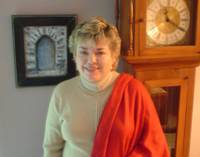
I stand between a clock and a door. Fittingly, I think.
The clock is the last of the many my father made. Solid cherry and a thing of beauty. I recognize that I have become a woman of a certain age and am surprisingly happy about this. My father attained his most valued personal achievements after fifty. So, the clock is hopeful. While it reads twenty past eleven, for all we know, this could be twenty past eleven in the morning! There is still time for me to live. And I have a strong sense that I get to choose whether it is morning or evening, whether my life is at its prime or its end.
And then there is the door, the painting I bought because I loved it. There it hangs, like an invitation. To open doors. To push on doors. To walk through and explore behind doors. To command doors to open. To bang on doors. I am here. To shout with Jacob, "I will not let you go until you bless me."
How fortunate I have been already in life, and yet, I dare to ask for more. I do not stand between a rock and a hard place, but between a clock and a door. Opportunities knocking, tick tocking.
Subscribe to:
Posts (Atom)
